Experiencing a motor vehicle collision is an inherently disorienting and stressful event for any driver. In the high-stress moments immediately following an impact, a surge of adrenaline and unexpected shock can obscure clear thinking and hinder decision-making. However, the precise actions taken during the initial thirty minutes after a crash establish a fundamental foundation for personal well-being, vehicle preservation, and the legal resolution of the incident. The paramount priority in any crash scenario must always be human life and physical safety. Drivers and passengers ought to take a collective breath, evaluate their physical condition for injuries, and determine whether immediate emergency medical attention is required.
If the collision occurs on a busy highway or active urban thoroughfare, moving surviving vehicles out of primary traffic lanes is crucial when the automobiles remain drivable. Unmoving vehicles sitting in active lanes present an immediate danger for high-speed rear-end collisions. Drivers should activate hazard warning lights immediately, deploy reflective emergency triangles or road flares if available, and exit the roadway to stand behind guardrails or elevated barriers whenever possible. If exiting the vehicle is unsafe due to high-speed traffic, remaining buckled securely inside the steel cabin offers far greater protection than walking across active traffic lanes.
Once immediate physical safety is secured, comprehensive scene documentation becomes the next essential task. Using a smartphone camera, motorists should capture extensive photographic evidence from multiple perspectives. This includes photographing wide shots of the overall scene, close-ups of panel damage on all involved vehicles, skid marks, road surface debris, weather conditions, visibility impediments, and traffic signals. Gathering contact information from non-involved witnesses is equally valuable, as unbiased third-party observations often help clarify conflicting driver accounts later on. Exchanging driver information, insurance details, contact phone numbers, and vehicle identification numbers with other drivers is a mandatory procedural step. However, drivers must remain cautious and avoid engaging in casual debates regarding fault or liability. Statements made in the heat of the moment can be misunderstood or used unfairly in later legal proceedings.
During these intense roadside situations, contacting a dependable roadside service provider yields immediate, practical support on the ground. Professional operators can assist with setting up traffic cones, securing loose bumper covers, jumping flat batteries, or stabilizing a crippled car while waiting for law enforcement officers to arrive and draft their official crash report. Taking these initial structured measures shields drivers from unnecessary legal exposure and creates a clear, documented record that repair technicians and insurance professionals will rely upon during the recovery process.
Professional Vehicle Transport and Triage Evaluation
Relocating a damaged vehicle from a collision site requires specialized equipment, technical knowledge, and careful handling. Attempting to drive an automobile that has suffered structural distortion, suspension misalignment, or fluid line fractures can transform minor body panel damage into irreparable mechanical failure. Furthermore, leaking fluids such as coolant, synthetic oil, or brake fluid pose severe environmental hazards and can ignite if exposed to hot exhaust manifolds. Dragging a disabled car using improper towing rigs can bend unibody frames, ruin expensive transmission gearboxes, and tear off delicate bumper valances.
Utilizing a certified towing service guarantees that trained operators employ heavy-duty flatbed haulers, nylon securement straps, and proper winching techniques. Professional transport operators evaluate gross vehicle weight ratings, tire rotation status, ground clearance, and attachment points prior to pulling a car onto a flatbed trailer. This careful loading protocol preserves whatever structural integrity remains, keeping the chassis completely stationary during transit to a dedicated holding facility or repair shop.
Upon arrival at the holding facility, technicians and damage assessors initiate a rigorous triage inspection to determine whether full vehicle restoration is financially and structurally feasible. Insurance adjusters work alongside master repair specialists to analyze whether estimated repair expenditures exceed the actual cash value of the vehicle prior to the collision. When structural impacts crush main passenger safety cells or fracture internal engine blocks beyond repair, the vehicle is formally declared a total economic loss.
In circumstances where a vehicle is deemed unrepairable, owners frequently evaluate salvage avenues, including disposing of junk cars through licensed scrap auto buyers to recoup residual material value or offset remaining auto loan balances. For vehicles that clear this initial triage evaluation with manageable damage, however, technicians generate a detailed repair plan, officially initiating the comprehensive step-by-step restoration workflow.
Administrative Claims Navigation and Estimate Authorizations
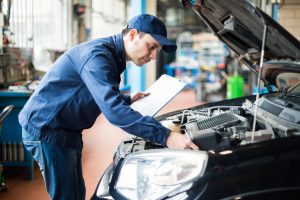
The administrative dimension of post-accident vehicle recovery often requires as much precision and attention as the physical wrenching and bodywork. Establishing effective communication between the vehicle owner, certified repair facilities, and insurance claim representatives is essential to maintain steady project progress. Once the vehicle is positioned inside an estimator bay, certified technicians conduct a meticulous tear-down inspection. They dismantle damaged exterior panels to expose underlying structural components, bracketry, and electrical harnesses that cannot be seen during initial roadside glances.
Estimators enter every damaged component into specialized industry software programs. These software tools compile updated original equipment manufacturer parts prices, specialized labor rates, paint materials costs, and standard repair duration guides to establish a comprehensive financial baseline. Collaborating directly with an established auto insurance agency helps streamline this initial claim submission, ensuring adjusters receive high-resolution diagnostic images and computerized line-item breakdowns without unnecessary administrative delays. Claims adjusters review these detailed filings to verify that each itemized repair correlates directly with the impact dynamics of the accident.
Decisions regarding original equipment manufacturer parts versus certified aftermarket components are also finalized during this administrative phase. Insurance contracts and vehicle warranties dictate whether factory-original sheet metal or high-quality equivalent replacements are utilized. During deeper structural teardowns, secondary hidden damage frequently comes to light. Technicians may discover cracked wiring harnesses, hairline radiator fractures, bent suspension subframes, or compromised exhaust hangers that were hidden behind plastic covers. Supplemental repair requests are immediately documented and submitted to the insurance provider for additional funding approval before major structural repairs proceed. Maintaining clear, transparent lines of communication ensures that every required auto service procedure is fully authorized, preventing unexpected financial out-of-pocket expenses for the owner while ensuring the vehicle is rebuilt to strict factory standards.
Chassis Realignment and Undercarriage Mechanical Repairs
With formal repair authorizations secured, technicians transition the vehicle into the structural repair center to address frame alignment, chassis geometry, and core mechanical driveline integrity. Modern automobiles are constructed using advanced unibody architecture engineered with crumple zones. These crumple zones are specifically designed to absorb and dissipate collision energy away from human occupants. While this engineering marvel protects human lives, it frequently results in bent unibody rails, twisted engine subframes, and shifted suspension mounting points that affect vehicle handling.
To evaluate and correct structural deformities, technicians employ computerized three-dimensional laser measuring systems. These high-tech scanners project laser grids across key target points under the vehicle, comparing current physical coordinates against original factory CAD blueprints down to the exact millimeter. To execute precision frame pulling and undercarriage component replacements, technicians elevate the vehicle on a heavy-duty auto lift, giving technicians complete, unimpeded access to the entire floor pan, steering linkages, and exhaust channels. Hydraulic pulling towers are clamped to the vehicle’s pinch welds, exerting thousands of pounds of controlled hydraulic pressure to pull distorted steel back to its exact factory dimensions.
High-strength steel components must be pulled with careful temperature monitoring to prevent weakening the metal’s molecular structure. Qualified technicians perform specialized squeeze-type resistance spot welding when replacing non-repairable structural rails, matching factory weld locations and strength profiles precisely. Once chassis alignment passes rigorous digital verification checks, certified mechanics shift their focus toward replacing broken mechanical components. Collision forces often fracture aluminum control arms, bend steering tie rods, crack transmission mounts, and puncture cooling radiators. Executing comprehensive mechanical repairs ensures that the automobile not only looks straight from the outside, but also tracks true down the highway, maintains proper steering feel, and functions reliably under extreme driving conditions.
Body Panel Restoration, Wheel Realignment, and Refinishing
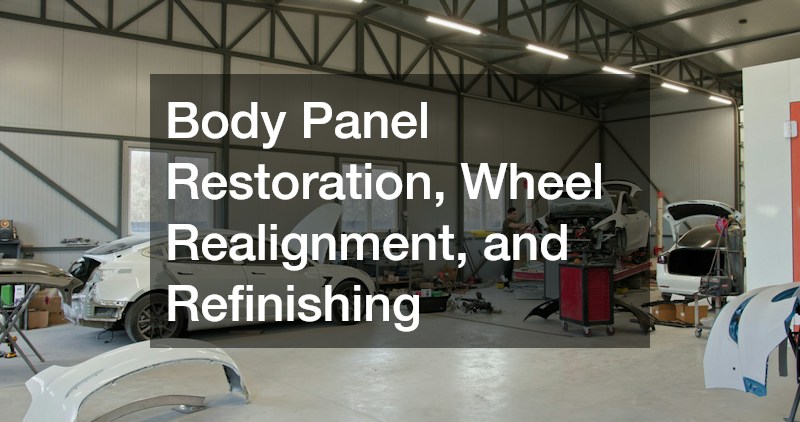
After verifying structural chassis dimensions and restoring core mechanical assemblies, the restoration process transitions into body panel reconstruction and multi-stage refinishing. Damaged doors, crumpled front fenders, crushed quarter panels, and bent hoods are either meticulously reshaped using specialized metalworking hammers and dollies or replaced entirely with certified sheet metal components. Technicians apply micro-layers of body filler over smoothed metal surfaces, hand-sanding the panels through progressive grit sequences until the exterior panel contours are perfectly seamless. Achieving exact panel gaps, uniform door reveals, and precise latch alignment is critical to ensure weather-tight cabin seals and eliminate highway wind noise.
While body panels are being prepared for refinishing, equal attention must be directed toward the vehicle’s rolling chassis and suspension geometry. A certified tire shop inspects all four wheels for subtle stress fractures, mounts replacement tires matched to factory specifications, and conducts four-wheel computerized alignments. This alignment process corrects camber, caster, and toe angles to prevent rapid tire wear and preserve vehicle stability during cornering.
Simultaneously, the automobile enters a sealed, downdraft spray booth for paint application. Technicians at a premier auto body shop utilize computerized color-matching tools to analyze the vehicle’s existing paint layer, compensating for subtle paint fading caused by solar radiation and environmental exposure. Master painters apply high-adhesion primers, computerized color basecoats, and durable clear coats. Once applied, painter specialists perform wet sanding and compounding steps to remove tiny dust nibs and smooth out clear coat orange peel textures. The clear coats are then baked under infrared heating lamps, producing a deep, high-gloss finish that matches original factory paint quality and protects underlying sheet metal against future corrosion.
Cabin Reconstruction, Glass Fitment, and Specialty Upgrades
Once the newly painted exterior panels have cured completely, the vehicle enters the final assembly and interior detail station. Damaged glass components, such as cracked windshields, shattered side windows, and broken rear defroster glass, must be removed and replaced using high-grade urethane bonding agents. A modern vehicle windshield provides up to thirty percent of overall cabin structural strength during a vehicle rollover and acts as the structural backstop for front airbag deployment. Therefore, clean glass prep work and proper urethane curing times are absolute safety requirements. Furthermore, technicians perform electronic recalibration on forward-facing cameras and radar modules mounted behind the windshield to restore advanced safety systems like adaptive cruise control and automatic lane keeping.
To complement the fresh glass installation and protect newly restored interior materials, vehicle owners often invest in professional auto window tinting services during final reassembly. Modern ceramic window films block up to ninety-nine percent of harmful ultraviolet rays and significantly reduce infrared heat buildup inside the passenger cabin. Additionally, quality window film provides extra shatter protection, holding glass fragments together if an impact occurs in the future.
Following glass fitment and tinting, interior detailing specialists meticulously clean every cabin surface. Industrial vacuum systems extract micro-glass particles and body shop dust from carpets, floor mats, and seat seams. Cabin air filters are replaced to clear out ambient dust accumulated during repair steps, and heating or cooling vents are thoroughly sanitized. Leather surfaces are conditioned, vinyl trim is treated, and electronic dashboard displays are cleaned with specialized non-abrasive formulas. The vehicle’s exterior receives a final hand wash, surface polish, and protective wax application, restoring the vehicle to showroom visual standards.
Comprehensive Quality Assurance and Vehicle Delivery
The culmination of the post-accident vehicle recovery master blueprint involves rigorous multi-point quality control testing before the vehicle is released to its owner. A master diagnostic technician performs a final computerized system scan, connecting diagnostic interface tools to evaluate all onboard electronic control modules. This step verifies that airbag sensors, anti-lock braking systems, blind-spot monitoring systems, and engine management electronics are active and operating completely free of diagnostic fault codes.
Following electronic diagnostic verification, the vehicle undergoes a comprehensive road test conducted across various road surfaces and driving speeds. Technicians test brake pedal feel, acceleration smoothness, steering centering, suspension compliance, and cabin acoustic isolation, ensuring that no unusual vibrations, squeaks, or tracking pulls exist. Every exterior light, power window, windshield wiper, and interior convenience feature undergoes a final manual inspection to verify flawless functionality.
Passing this final quality audit provides automobile owners with total assurance that their vehicle has been restored to pre-crash condition. Receiving the keys back to a perfectly restored automobile turns a stressful, disruptive event into a positive milestone. By adhering strictly to a professional, step-by-step restoration blueprint, vehicle owners safeguard their long-term monetary investment, preserve vehicle longevity, and hit the open road with complete confidence in their automobile’s performance and safety.